What your last inspection didn’t catch
A floating roof tank. A seal failure developing over 72 hours. Product vapour accumulating in the annular space. The next scheduled inspection: four days away. The operator on round that morning: nothing unusual noted.
A composite scenario drawn from common incident patterns in tank terminal operations.
This is not a hypothetical designed alarm. It is a pattern that repeats itself across the industry. Not because terminal operators are negligent, but because the tools available to them were built for a different era. Manual rounds, periodic inspections and reactive maintenance were reasonable solutions when they were designed. They are increasingly inadequate for the risk profile of modern tank terminals.
The question is not whether your inspection program is thorough. The question is whether it is continuous.
Spotting trends with AI detection
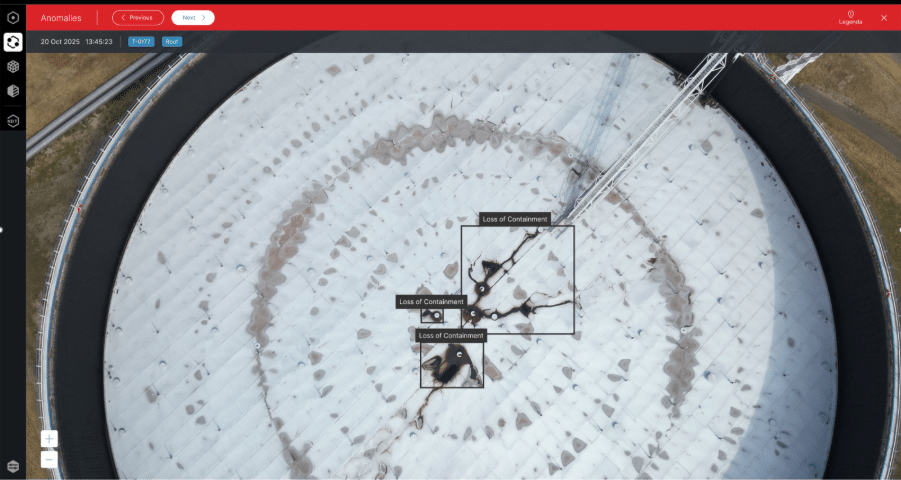
Falcker’s safety-critical detection capabilities are built on a simple premise: the conditions that precede a serious incident are visible before the incident occurs. Smoke before fire. Product sheen before containment loss. Vapour haze before ignition. If you can see these conditions early enough and respond fast enough, you prevent the incident rather than manage its aftermath.
Our production-ready models cover the three highest-consequence failure modes in tank terminal operations.
The time gap between inspections
Most storage tanks are inspected on an annual or biannual cycle. Between those fixed intervals, the asset is monitored primarily by operator rounds. Typically, this happens once or twice per day, on foot or by vehicle, covering dozens of tanks across a large site. The operator is looking for obvious signs of trouble: visible leaks, unusual odours or changes in tank level.
What they cannot reliably detect is everything that is developing below the threshold of immediate visibility. Early-stage seal failure. Vapour accumulation. The first signs of a floating roof tilting under uneven loading. These are conditions that, left undetected for hours or days, can escalate into the category of incidents that close terminals and end careers.
“The inspection gap is not a failure of process. It is a fundamental constraint of human-scale monitoring applied to industrial-scale assets.”
The speed advantage
Incident response in terminal operations is a race against escalation. The time between first visible sign and dangerous condition is measured in hours for containment failures. Even in minutes for fire and smoke events. The value of AI detection is not simply that it catches what humans miss, it is that it catches it immediately.
Our real-time alerting system triggers notification messaging the moment a high-priority anomaly is detected. Your response team receives an alert before the condition has had time to develop. The difference between a contained incident and a major event is frequently measured in the speed of the first notification.
Our detection models have been built on an annotated dataset, covering hundreds of storage tanks and thousands of high-resolution inspection images.
Autonomous rounds, continuous coverage
Our platform supports fully autonomous drone operations via Dock systems. Drones that fly programmed inspection routes and return without requiring an on-site pilot for every mission.
This means daily operator rounds can be complemented by high-frequency aerial monitoring that covers the entire tank farm on a schedule that no human team can match. The drone captures. The AI analyses. Your team responds to findings, not to the task of looking for them.
For terminal operators managing large asset bases with constrained inspection resource, this is not a marginal improvement. It is a structural change in the economics and effectiveness of safety monitoring.
Human oversight remains essential
A note on what AI detection does not do: it does not replace the professional judgement of an experienced inspector or operator. Our platform is built on a philosophy of AI-augmented decision making. The AI flags, the human verifies and acts.
When a detection event is triggered, the alert reaches a qualified operator who reviews the evidence and decides the response. This is not a bureaucratic constraint on technology. It is a deliberate design principle, grounded in the understanding that safety-critical decisions in regulated environments require human accountability.
“The AI extends the reach and speed of your team. It does not replace them.”
What this means for your operations
If you are a terminal operator or HSE manager, the practical implication is straightforward: the window between the development of a dangerous condition and your team’s awareness of it can be reduced from days to minutes. That reduction has a direct relationship with your incident rate, your insurance exposure, your customer satisfaction, your regulatory standing and the safety of your people and the communities around your facility.
Our fire, smoke, and loss of containment detection capabilities are available now.
The question worth asking is not whether AI-powered inspection is the future of terminal safety. It is whether you want to be operating without it for another inspection cycle.