Faster inspections and emergency response at Dutch terminals
From 26 November 2026, the Netherlands opens parts of the control zones (CTRs) around its civil airports to drone flights without prior permission from air traffic control. The change covers the CTRs of Schiphol, Rotterdam, Groningen, Maastricht and Lelystad. For tank terminals and chemical sites inside these zones, it removes the biggest practical barrier to routine inspection flights and rapid incident response.
This change exists because three organisations worked on it together. Air Traffic Control Netherlands (LVNL), the Directorate-General for Aviation and Maritime Affairs (DGLM) of the Ministry of Infrastructure and Water Management, and the Human Environment and Transport Inspectorate (ILenT) developed a new airspace layout that keeps manned aviation safe and makes room for useful drone operations. The government explicitly names inspection of vital infrastructure as one of the goals. We want to thank all three for their work and for the careful, safety-first approach behind it.
What changes on 26 November 2026
Drone pilots no longer need to contact air traffic control in parts of the CTR. A CTR has a radius of about 15 km around an airport. From about 5 km out, departing and landing aircraft fly higher, which leaves room for drones which fly closer to the ground.
| Zone | What changes from 26 November |
|---|---|
| Zone 1 | No change |
| Zone 2a | Specific category flights without air traffic control permission, provided other operational conditions are met |
| Zones 2b and 4 | Specific category flights without permission, as long as the drone stays within 30 metres of buildings or other obstacles |
| Zone 3 | Open and Specific category flights without permission |
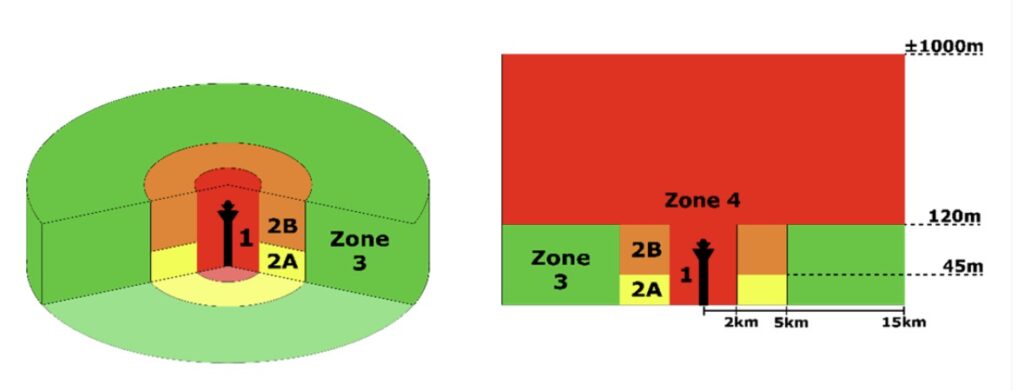
Military airports are not part of the change. Other geographic restrictions, such as zones around helicopter landing sites and vital infrastructure, still apply. You can find the new zones in the GoDrone app and Aeret.
What this means for terminals in Rotterdam, Amsterdam and Chemelot
Daily drone flights become much more flexible for terminals along the Rotterdam port area from Pernis to Europoort, and for terminals in the Amsterdam port area and at Chemelot. Until now, every flight in a civil CTR had to be planned ahead: under the LVNL procedure, a mission plan goes into GoDrone at least two days before the flight, final times follow one working day before, and the pilot keeps two-way radio contact with air traffic control. From November 26th all these procedures and restrictions are no longer necessary.
The 30-metre rule in zones 2b and 4 fits the way terminals are inspected. Tank roofs, shells, pipe racks and jetties are inspected from close by, so most inspection flights stay well within 30 metres of an obstacle.
An Eye in the Sky within five minutes
During an incident, terminals can now have an Eye in the Sky with a live video stream in the air within five minutes. Without the wait for air traffic control, emergency response teams get a live overview of the situation before anyone enters the area. That helps them decide faster and keeps people out of harm’s way.

Operator Round: terminal operators fly their own inspection rounds
Our programme in which terminal operators are trained to carry out pre-programmed inspection flights themselves can now do these flights without the hustle of mandatory RT communication with ATC at these terminals. Operator Round replaces manual rounds with automated, programmed flights along a fixed route. Because the route is the same every time, images are comparable over time and changes stand out. Until now, the CTR planning process made this impractical for terminals near Schiphol, Rotterdam and Maastricht. From 26 November, it becomes part of the daily routine.
“This is the change our customers in the port areas have been waiting for. Routine inspection flights no longer need days of pre-planning, and in an emergency a live picture is available within minutes. We thank LVNL, DGLM and ILenT for making this possible together, and for the care they took to balance safety with room for drone operations.” Duco Boer, Managing Director, Falcker and Treasurer of the association of Dutch certified RPAS Operators (DCRO)
FAQ
Do I still need air traffic control permission to fly a drone in the Rotterdam CTR after 26 November 2026?
It depends on the zone. In zones 2a and 3, and in zones 2b and 4 within 30 metres of obstacles, no permission is needed for Specific category flights. Zone 1 does not change.
Which airports does the change cover?
The civil airports Schiphol, Rotterdam, Groningen, Maastricht and Lelystad. Military airports are excluded.
Do other drone restrictions still apply?
Yes. Zones around helicopter landing sites, vital infrastructure and other restricted areas remain in place. Always check the location before you fly.
Where can I see the new zones?
In the GoDrone app and Aeret, once the new layout is published there.
What does this mean for Operator Round at my terminal?
If your terminal is in one of the opened zones, trained operators can fly pre-programmed inspection rounds without planning each flight days ahead. Contact us to check what applies to your site.