A day in the life of a Falcker drone pilot
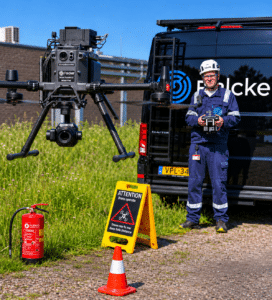 Hundreds of storage tanks spread across an industrial port area. Each one needs to be regularly inspected. Thoroughly, safely and efficiently. Where inspectors once required scaffolding to check the tank at height, Falcker drone pilot Nick now sends a drone up instead. But Nick isn’t just flying a drone, in a single flight he gathers all the data needed to assess a tank’s condition in full detail. Feeding it straight into Falcker’s inspection software, where every image becomes the insight that keeps the terminal running safely.
Preparation: before the drone leaves the ground
Nick’s day on a storage terminal starts well before the first flight. After understanding which assets need to be inspected he makes a flight plan. Work preparation and flight engineering is done at the desk and the batteries are charged during the drive to the site, so no time is wasted on arrival. The first stop is always the work permit desk to receive his permit to workOnce on site, the team scouts the take-off and landing area, marks the zone with cones, places a fire extinguisher nearby and does a full physical pre-flight check of the drone. Feeling for cracks in the propellers, checks that nothing is loose. Only then does the drone goes up in the sky.
What gets captured during a tank inspection
A single tank inspection means approximately 700 photos. Around 70 per position, across multiple altitudes and angles, with the drone completing a full 360-degree pass around the tank. All images are stored on a secure SSD at the end of the day and processed into a detailed 3D model used for Falcker’s asset intelligence platform “Condition Monitor” . These high resolution images give full visual coverage and more details to our customers than traditional inspection methods. In the Falcker software customers can compare assets overtime and understand the real condition of their assets
Beyond standard photo capture, we also carry out Optical Gas Imaging (OGI). Using a thermal camera to detect gas leaks and emissions invisible to the naked eye. The results can be critical.
“We’ve regularly found leakin“We regularly find tanks that need immediate attention. Tanks with leaking seals or vents in the roof wherehydrocarbon emissions are pouring out. You don’t want to send a worker up there to find that.” tanks that needed immediate attention. Tanks with a hole in the roof with emissions pouring out. You don’t want to send a worker up there to find that.”
The real challenges: wind, birds and site rules
Flying above tank terminals comes with a unique set of challenges. Cranes positioned near tanks can block flight paths. During breeding season, gulls and oystercatchers can become territorial towards the drone and the pilot. That requires extra awareness from the pilot.
Wind is another constant factor. Falcker operates within a maximum of 12 metres per second for gusts, but even within that limit, flying between tanks can create unpredictable tunnel effects that make take-off and landing harder.
On top of that, every terminal has its own set of rules. Especially around Atex limitations or PBM requirements. What’s permitted at one site may not be allowed at the next. Staying sharp on those differences is part of the job.
What sets Falcker apart
When asked what differentiates Falcker from other drone operators in the port area, Nick doesn’t hesitate: safety and compliance.
That reputation shows in customer reactions too. Terminal staff regularly approach Nick after Site Explorer flights, Falcker’s software product for aerial mapping, to say how useful it is for day-to-day operations: directing workers, planning logistics and getting a clear overview of the entire site.
Looking ahead: BVLOS and the future of tank inspection
How he sees the future? Nick foresees more BVLOS, Beyond Visual Line of Sight: operating drones entirely from behind a computer screen, without ever being on site. For automated data acquisition of the digital Operator Round software, Falcker is already flying BVLOS on a daily bases. We use different kinds of technologies for what suits best at the terminal we are flying for.
Drone-based tank inspection is no longer experimental. It delivers accurate 3D models, detects invisible gas leaks and removes workers from hazardous situations, all faster and more precisely than traditional methods. For Falcker, that’s not just a service. It’s the standard.
Want to know more about drone-based tank inspection, optical gas imiging or our Site Explorer?
Get in touch with us: info@falcker.com