How to monitor the condition of storage tanks across a tank farm
To monitor the condition of storage tanks across a tank farm, track two things for every tank: how it operates and what state its structure is in. Inspect each tank on a schedule based on API 653 or EEMUA 159 and store every finding against one asset record. Then compare tanks side by side to see which ones need attention first.
Tank gauging and control systems usually cover the operational side. The structural side is where data tends to scatter, across contractor reports, spreadsheets and maintenance systems. This guide covers that side, and how Falcker’s Condition Monitor brings the data together in one place.
Operational monitoring vs structural condition
Operational monitoring shows what is happening inside a tank right now; structural condition monitoring shows whether the tank itself can safely stay in service.
| Aspact | Operational monitoring | Structural condition monitoring |
| What it track | Product level, temperature, inventory, overfill and leak alarms | Shell and floor corrosion, roof and seal condition, settlement, coating, foundation |
| How data is collected | Gauges and sensors, continuously | Routine visual checks, periodic inspections, thickness measurements |
| Main users | Control room and operations | Integrity, inspection and maintenance teams |
| Key question | Is the tank operating safely today? | Can the tank stay in service, and for how long? |
Terminals need both, but each relies on different data. A level gauge will not show a corroding floor or a tank that is settling unevenly.
How to monitor tank condition across a storage tank facility in five steps
Monitoring condition across a tank farm comes down to five steps: one tank register, one inspection plan, consistent data capture, regular assessment and site-wide priorities.
- Build one register of every tank. List each tank with its ID, location, design data, product, roof type and inspection history. Use the same asset reference in every inspection report, so findings from different contractors and years add up.
- Set an inspection plan per tank. Base the intervals on the standard you follow, local regulations and the tank’s risk. A tank that stores a corrosive product, or has a history of findings, needs a shorter interval than a low-risk tank.
- Capture data the same way every time. Use standard checklists for routine, in-service and out-of-service inspections. Record photos, measurements and NDT results, such as ultrasonic thickness readings, against the tank and the exact inspection location. Standardized data stays comparable between inspectors, contractors and years.
- Assess fit for service and track trends. After each inspection, check the results against the acceptance criteria of your standard, such as minimum shell and floor thickness and allowable settlement. Then look at the trend: the corrosion rate tells you how long a tank can stay in service before it needs repair.
- Prioritize across the whole site. Compare tanks side by side on condition, risk and remaining life. Plan repairs and turnarounds for the tanks that need them first, and adjust inspection intervals as new data comes in.
How often should storage tanks be inspected?
API 653, the American Petroleum Institute standard for tank inspection, repair, alteration and reconstruction, sets four inspection intervals for above-ground storage tanks.
| Inspection | Maximum interval under API 653 |
| Routine in-service inspection by your own staff (visual, from the outside) | One month |
| External inspection by an authorized inspector | 5 years, or RCA/4N years if that is shorter |
| Ultrasonic thickness measurement of the shell | 5 years if the corrosion rate is unknown; otherwise RCA/2N years or 15 years, whichever is less |
| Internal (out-of-service) inspection by an authorized inspector | 10 years for the first inspection, longer with credited safeguards such as a lining, cathodic protection or a release prevention barrier. Later intervals follow the measured floor corrosion rate, up to a maximum of 20 years (30 years with a release prevention barrier) |
RCA is the remaining corrosion allowance of the shell (measured thickness minus minimum required thickness); N is the shell corrosion rate per year. A risk-based inspection (RBI) assessment under API RP 580 can replace the default internal interval with one based on each tank’s actual risk. EEMUA 159 also supports risk-based inspection, alongside time-based and condition-based approaches. Always check the current edition of your standard and the local rules for your site.
How Falcker’s Condition Monitor supports each step
Condition Monitor is Falcker’s inspection and integrity platform for storage tanks. It brings the data behind all five steps together in one place.
- Tank register: tank properties, documents and the full inspection history are stored per tank, with a 3D model of tank components linked to the inspection data.
- Inspection plan: both time-based and risk-based inspections are supported, so each tank’s intervals can follow its risk.
- Data capture: configurable checklists standardize visual inspections across inspectors and contractors, and NDT results are stored against the same tank.
- Assessment: API 653 and EEMUA 159 fit for service assessments run automatically, including settlement calculations, and trend data shows how each tank degrades over time.
- Priorities: repair advice compares each tank’s calculated and target lifespan and recommends standard repairs to close the gap.
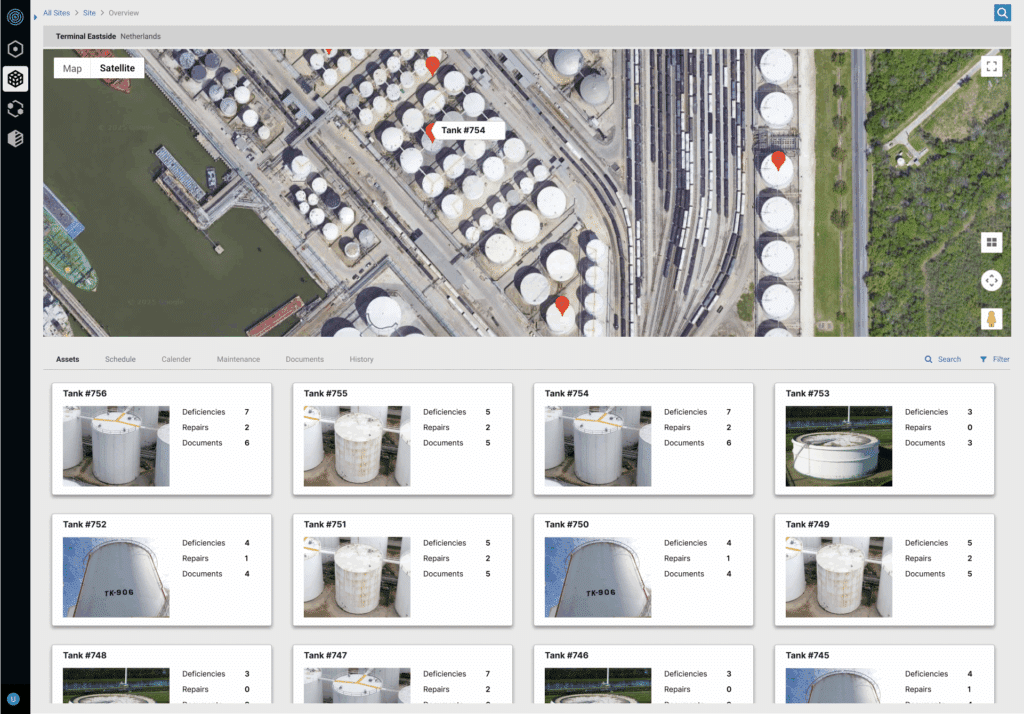
For a site-wide picture, Condition Monitor works alongside Site Explorer, a 360° view of the whole terminal, and Operator Round, which digitizes routine operator rounds. Request a demo to see Condition Monitor with your own tank data.
Frequently asked questions
What is the difference between tank monitoring and tank inspection?
Tank inspection is a scheduled check of a tank’s structure by qualified people; tank monitoring is the ongoing tracking of a tank’s operation and condition over time. Each inspection adds data points that show how the condition of a tank is changing.
Can a storage tank be inspected without taking it out of service?
Yes, for the outside of the tank. Routine visual checks, external inspections and shell thickness measurements are all done while the tank stays in service. A full inspection of the floor usually requires an out-of-service inspection.
How do you decide which tanks to inspect or repair first?
Rank tanks on two factors: likelihood of failure and consequence of failure. Likelihood comes from inspection data such as corrosion rate, remaining thickness and settlement. Consequence depends on the product, the size and location of the tank, and what a leak would affect. Tanks that score high on both come first.