How to prove your storage tank risk was known, managed and compliant
When a storage tank incident happens, or a near miss, after understanding “what went wrong?” Quickly comes the question It’s “was it a known risk, and did we take mitigating actions to limit the exposure?”. For asset integrity managers running aging tank farms, being able to answer these questions with data, is what separates a defensible risk management program from a vulnerable one.
What does “defensible” actually mean for tank integrity?
A defensible integrity program can show, for any tank and its equipment, at any point in time: what condition it was in, what was measured, what standard that assessment was measured against, who signed off on it and why the resulting decision. Inspect now, defer, or repair was the right one given the data available. It’s the difference between “we inspect regularly” and “here is the fit-for-service calculation, the standard it complies with and the audit trail behind it.”
Why RBI models often fail the defensibility test
Risk-based inspection (RBI) is supposed to solve this, but in practice many programs struggle. RBI methodologies (API 580/581, EEMUA 159) require knowledge of degradation mechanisms and the correct assessment of probability and consequence of failure. This is a different discipline than simply maintaining fixed inspection intervals. In addition, historic inspection data, NDT and repair data needs to be present and complete for accurate calculations on the risk taken. The bar keeps rising: as asset integrity becomes “a strategic pillar” of energy and industrial growth. Rather than a routine maintenance task, operators running decades-old infrastructure under higher utilization face closer scrutiny from regulators and insurers, particularly after industry incidents.
Third-party validation is becoming the new bar for RBI credibility
It is not only willingness, it is also that limited available RBI knowledge at current staff. This is why independent validation matters. Falcker’s RBI software is qualified by KIWA against its own reference model and confirmed the software could “correctly perform and document RBI assessments in full compliance with EEMUA 159”. The leading standard for inspection and maintenance of aboveground vertical cylindrical steel storage tanks.
From automated assessment to an auditable trail
Falcker’s Condition Monitor platform is built around this defensibility gap. It combines a 3D digital twin of each tank with drone-collected visual, geometric and gas emission data, and non-destructive testing (NDT) results uploaded on-site or remotely. From that single dataset, it automatically calculates fit-for-service assessments against PED, API 653 and EEMUA 159. It stores every historical measurement, prediction and repair decision in one searchable, exportable record.
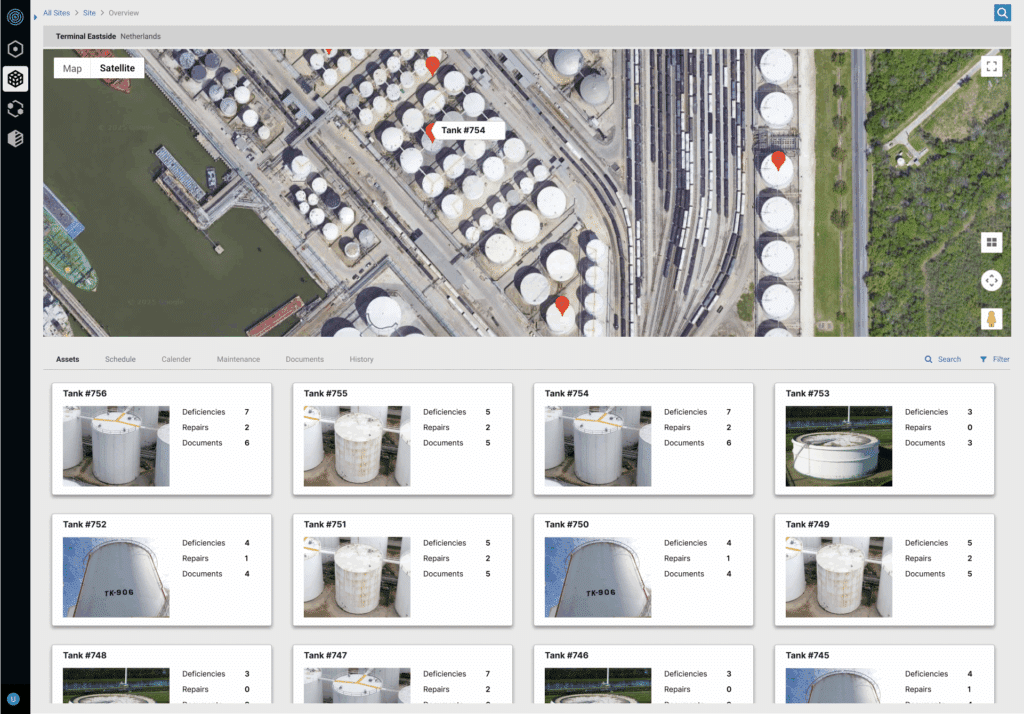
In practice, this means an internal maintenance team and an external inspection contractor can work from the exact same record. Including completing mandatory EEMUA 159 and PGS-29 assessments remotely, instead of each rebuilding their own version of a tank’s history from scratch. That shared, single source of truth is what gives an integrity decision its audit trail. Whether the review that follows is an internal audit, an insurer’s assessment, or a regulatory inspection.
Common questions
What does EEMUA 159 require for storage tank inspection?
It sets inspection intervals, fit-for-service assessment methods, and documentation requirements for aboveground vertical cylindrical steel storage tanks and was updated to its 6th edition in April 2025.
How is Falcker’s RBI software validated?
KIWA tested Falcker’s calculations against its own reference model and confirmed compliance with EEMUA 159.
Can automated assessments replace an inspector’s judgment?
No. Automated fit-for-service assessments give inspectors and asset integrity managers a consistent, data-backed starting point, so their expertise is applied to genuine exceptions rather than routine recalculation.
For terminal operators trying to defend maintenance budgets, satisfy auditors and reassure insurers at the same time, the goal isn’t more inspection, it’s an integrity record that can withstand one simple question: how do you know?