A definition for oil & gas and tank terminals
Asset Intelligence software for oil and gas is a platform that brings the inspection, condition and engineering data of physical assets, such as storage tanks and piping, together in one record per asset, and turns that data into decisions on integrity, inspection planning, maintenance and budgets.
In short: asset data tells you what you have and what you measured. Asset Intelligence tells you what to do next, and when.
Why does Asset Intelligence matter for oil & gas operators?
Asset Intelligence matters because most oil & gas sites already collect plenty of asset data, but it sits in too many places to support a decision.
At a typical tank terminal or refinery, inspection findings arrive as contractor PDFs. Wall thickness readings live in spreadsheets, work orders sit in a CMMS module and site photos end up in shared folders. Each inspection is a snapshot, and the trend between two snapshots gets lost.
The result is that simple questions take days to answer. Which tank needs work first? Can this tank stay in service until its next inspection? What will maintenance cost over the next five years? Sites run tens or hundreds of tanks with fewer experienced inspectors, and auditors expect traceable records. Those questions need an answer that is current, consistent and easy to prove.
How does Asset Intelligence software work?
Asset Intelligence software works in four steps: it captures asset data, structures it per asset, analyses it against engineering standards and turns the result into a decision.
- Capture. Data comes from visual, geometric and gas emission inspections, NDT measurements such as ultrasonic wall thickness, tank data sheets and site imagery. It is collected by inspectors with digital checklists, by inspection contractors and by automated drone flights.
- Structure. Every finding is linked to one asset reference: a tank, a shell course, a nozzle, a pipe segment. The same asset looks the same in every report, whoever inspected it.
- Analyse. The software applies engineering rules and AI. Engineering rules cover fit for service assessments to API 653 or EEMUA 159, settlement evaluations and remaining lifetime calculations. AI flags early signs of corrosion, deformation or structural damage in images and shows how condition changes across inspection cycles.
- Decide. The output is something a team can act on: the next inspection date, a repair scope, a budget for the coming years or a decision to keep a tank in service.
Step 4 is what separates Asset Intelligence from a dashboard. A dashboard shows the data; Asset Intelligence connects it to the next action.
How often should storage tanks be inspected?
RCA is the remaining corrosion allowance of the shell (measured thickness minus minimum required thickness); N is the shell corrosion rate per year. A risk-based inspection (RBI) assessment under API RP 580 can replace the default internal interval with one based on each tank’s actual risk. EEMUA 159 also supports risk-based inspection, alongside time-based and condition-based approaches. Always check the current edition of your standard and the local rules for your site.
Asset Intelligence vs asset integrity management, APM, CMMS and digital twins
Asset Intelligence does not replace these systems; it is the layer that combines their data per asset and turns it into decisions.
| Term | What it is | Main question it answers | Typical data |
| Asset integrity management (AIM) | The processes and procedures that keep equipment safe and fit for service over its life | Is this asset safe to operate? | Inspection plans, findings, fit for service assessments |
| Asset performance management (APM) | Software focused on equipment reliability and availability, often driven by sensor data | How do we prevent the next failure or trip? | Process and sensor data, failure history |
| CMMS or EAM | The system of record for maintenance work, materials and costs | What work is planned and who does it? | Work orders, spare parts, costs |
| Digital twin | A digital model of a physical asset, often in 3D | What does the asset look like now? | 3D models, imagery, scans |
| Asset Intelligence | The layer that links data from all of the above per asset and analyses it | What should we do next, where and when? | All of the above, connected per asset |
For storage tanks, the overlap with asset integrity management is largest. Asset integrity management sets the rules; Asset Intelligence makes them run on current data. Asset management in the ISO 55000 sense is the management system around all of this, and Asset Intelligence is one of the tools that feeds it with evidence.
What questions does Asset Intelligence answer at a tank terminal?
At a tank terminal, Asset Intelligence answers the questions that decide inspection scope, maintenance budgets and whether a tank stays in service.
| Decision | The question | Data it needs |
| Inspection planning | Which tanks are due this year, and which can safely wait? | Last inspection dates, condition trends, time-based or risk-based intervals |
| Fit for service | Can this tank stay in service until its next inspection? | Wall thickness, floor scan, settlement survey, API 653 or EEMUA 159 assessment |
| Maintenance scope | Which repairs are needed, and in what order? | Findings per asset, severity, repair history |
| Budget | What will tank maintenance cost over the next three years? | Repair scopes, rates, remaining lifetime per tank |
| Daily operations | What has changed on site since the last round? | Recurring images of roofs, rim seals, bunds and drainage |
How does Falcker apply Asset Intelligence?
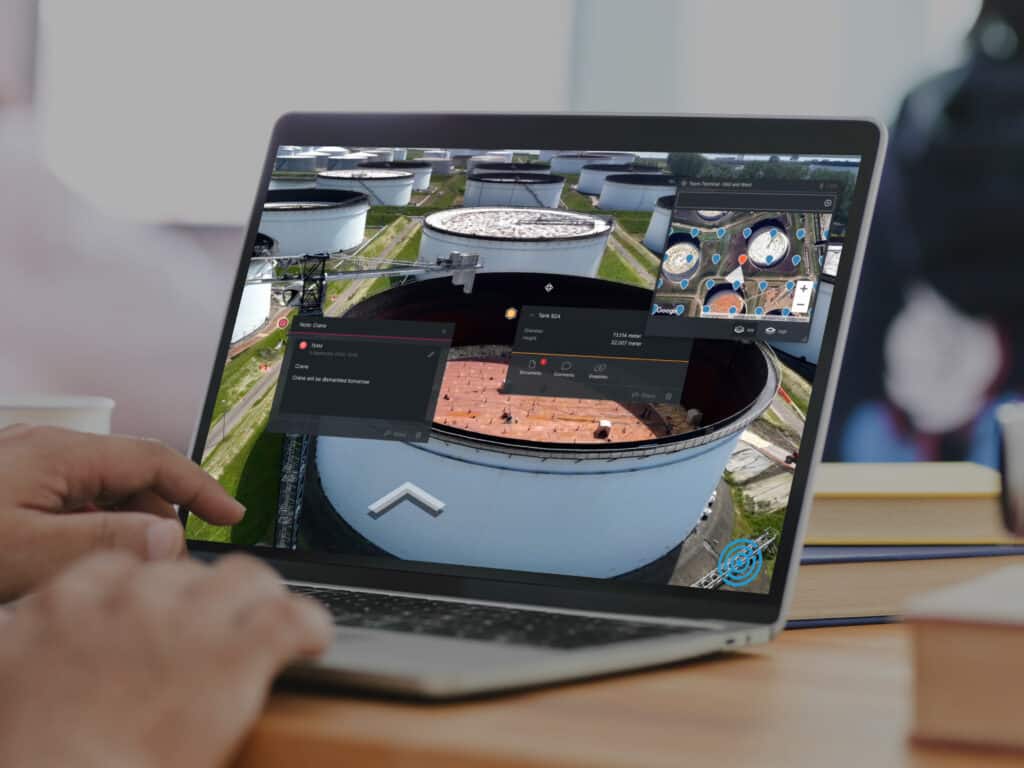
Falcker has build an Asset Intelligence software platform for tank storage terminals, refineries and petrochemical sites, with four applications on one platform.
Site Explorer: a complete, remote-accessible overview of the facility, built from 360° aerial images.
Condition Monitor: standardised visual inspections, a 3D model of tank components linked to inspection data and automated settlement calculations, supporting audit compliance with API 653 and EEMUA 159.
Lifecycle Planner: shows how maintenance choices affect remaining lifetime and next inspection intervals, and turns scope scenarios into budget estimates.
Operator Round: operator rounds carried out with automated drone flights, with an image record of every round.
Across the platform, inspectors and contractors record digitised NDT data, run fit for service assessments and remaining lifetime calculations, and plan both time-based and risk-based inspections. The platform connects to ERP or CMMS systems through an API, and inspection data stays owned by the client. Implementation takes 4 to 8 weeks on average from kick-off to go-live.
Frequently asked questions
What is Asset Intelligence in simple terms?
Asset Intelligence means using all the data you have about a physical asset to provide decision support on what to do with it next. For a storage tank, that means combining inspection findings, measurements and history into one view of its condition, remaining lifetime and next inspection date.
Is Asset Intelligence the same as asset integrity management?
No. Asset integrity management is the discipline and its procedures; Asset Intelligence is the software layer that feeds those procedures with current, connected data. A site still needs its integrity programme, and Asset Intelligence makes it faster to run and easier to prove.
Does Asset Intelligence software replace inspectors?
No. Inspectors and integrity engineers still collect data and make the final judgement. The software standardises how findings are recorded, runs the calculations and keeps the history, so engineers spend less time on reports and more on decisions.
Which standards does Asset Intelligence software for storage tanks work with?
For above-ground storage tanks, the main standards are API 653 and EEMUA 159 for inspection and fit for service assessment. Risk-based inspection programmes usually follow API 580 and API 581. Good software shows which standard each calculation is based on.
Is Asset Intelligence the same as predictive maintenance?
Not exactly. Predictive maintenance forecasts failures of individual machines, often from live sensor data. For static assets such as storage tanks, Asset Intelligence tracks degradation over time and supports the move from time-based to risk-based inspection and maintenance planning.
How long does it take to implement Asset Intelligence software?
It depends on the number of sites and the state of the existing data. At Falcker, the average from kick-off to go-live is 4 to 8 weeks.